
MHUR Beginner Guide: Team Play, Skill Cards and Revival
Learn My Hero Ultra Rumble match basics: three-player teams, skill-card upgrades, civilian interactions, revival resources and safe first drills.
FAQ
How many players are on a MHUR team?
What do skill cards do?
What is needed to revive a defeated teammate?
Do revived teammates lose all their skill levels?
Learn the team loop first
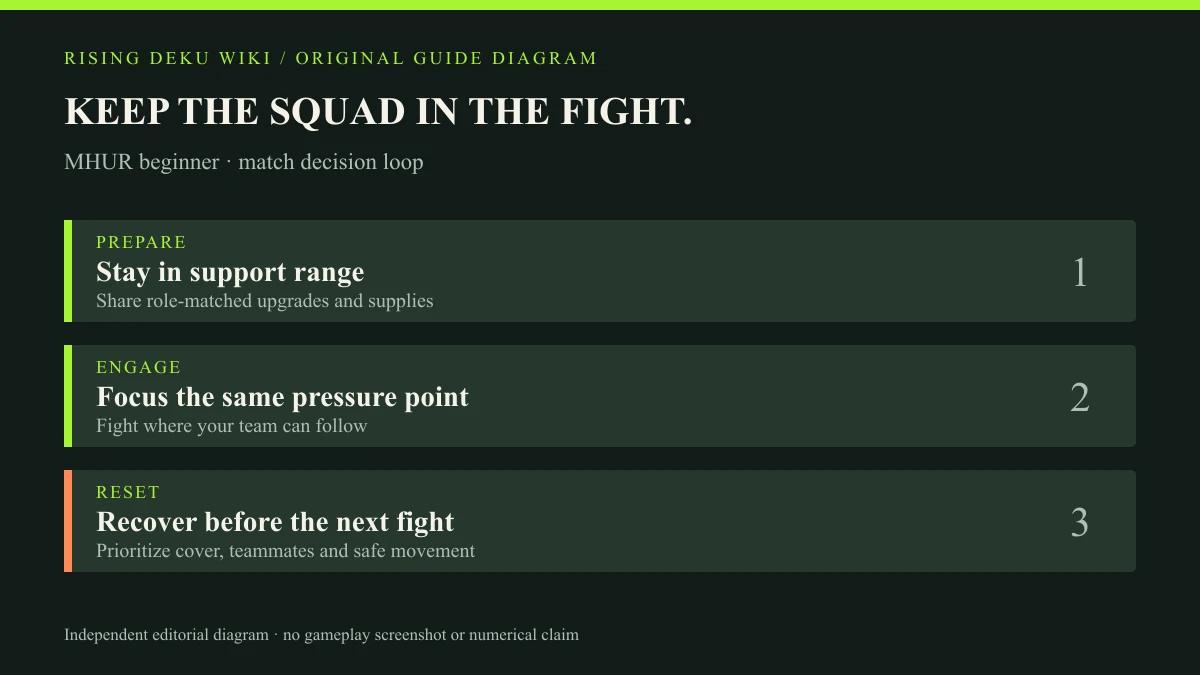
The standard mode is a 24-player battle royale with teams of three. Bandai Namco’s game page describes finding items, interacting with civilians and combining character abilities. Winning a single duel is only part of the match: your team also needs resources and a position it can defend.
For your first matches, choose a landing area together, stay within practical reach of allies and move toward the next safe position before the team is forced apart. These are beginner recommendations rather than a guaranteed winning route; map pressure and nearby teams change the decision.
Know your equipped character and skills
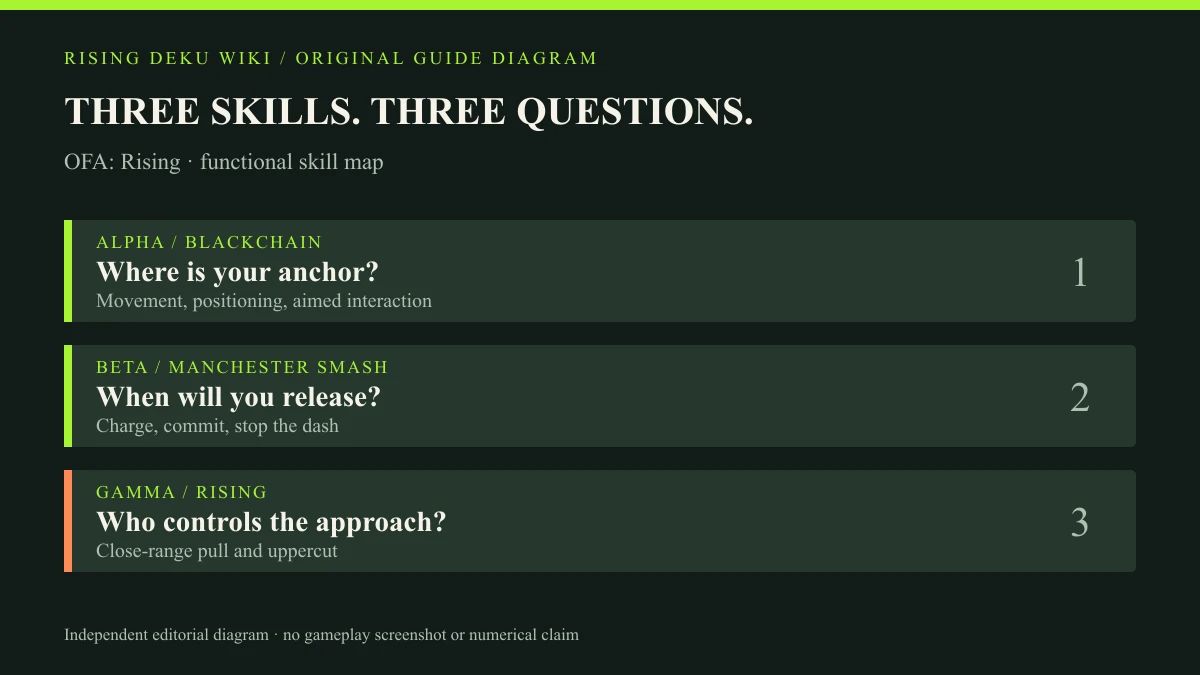
Read the selected character, role and Battle Style, then inspect alpha, beta, gamma and the Special Action. A nickname is not a full loadout description. This matters particularly for Deku: base Izuku, original OFA and Technical Rising should not be treated as the same kit.
Use the Deku variant checklist when a guide appears to show different attacks. If you chose the new style, the Rising overview explains its anchor movement and chargeable rush. Do not assume that acquiring a costume also acquired the matching kit; the unlock guide distinguishes rewards.
Loot for upgrades, then share
The official launch introduction describes collecting skill cards to upgrade Quirks. Bandai Namco’s gameplay guide distinguishes Quirk Skill Cards, which upgrade the specified alpha, beta or gamma, from Level Up Cards, which let you choose a skill. It also describes using other characters’ cards for temporary ability effects. The community battle royale gameplay guide explains the color and role relationships in more detail.
Read the card’s color and label rather than grabbing it only because it is nearby. Check whether it directly upgrades your own skill or is more useful to an ally. Keep enough inventory awareness to communicate useful cards instead of leaving the team to discover them independently.
Choose a first skill priority around an ability you understand. An upgrade is easier to use when you know its range, input behavior and recovery. For Rising, the practice guide separates those variables so you can compare levels without inventing a universal best build.
Civilians are a resource interaction
Official materials describe rescuing or intimidating civilians to receive useful items. Learn your character’s available interaction and check the surrounding space before stopping to use it. A resource interaction can leave you exposed if you ignore nearby opponents.
This is also a reason to look beyond direct combat while moving through the map. If your team needs resources, communicate that need and regroup afterward instead of turning one interaction into a long solo detour.
Downed and defeated are different situations
When an ally is downed, consider whether you can help them safely with the options your character provides. Do not confuse a downed-ally interaction with bringing a fully defeated teammate back into the match.
The official open-beta introduction describes recovering a defeated teammate’s badge and using Revival Cards. The community gameplay guide describes assembling a complete revival card from gray cards. Check your current item screen for the required resources, then find a safe place and moment to use them.
Older beginner videos may describe revived players losing all skill upgrades. The official 1.10.0 patch notes changed this: revived players retain their Quirk skill levels. Do not spend the next rotation following an outdated level-reset assumption.
Your first combat habit: keep an exit
Before attacking, identify the cover or route you would use if another team arrived. Attack near allies when possible, and look at the landing position of a movement skill as well as its starting position. A long chase can separate you from support even when the first hit connects.
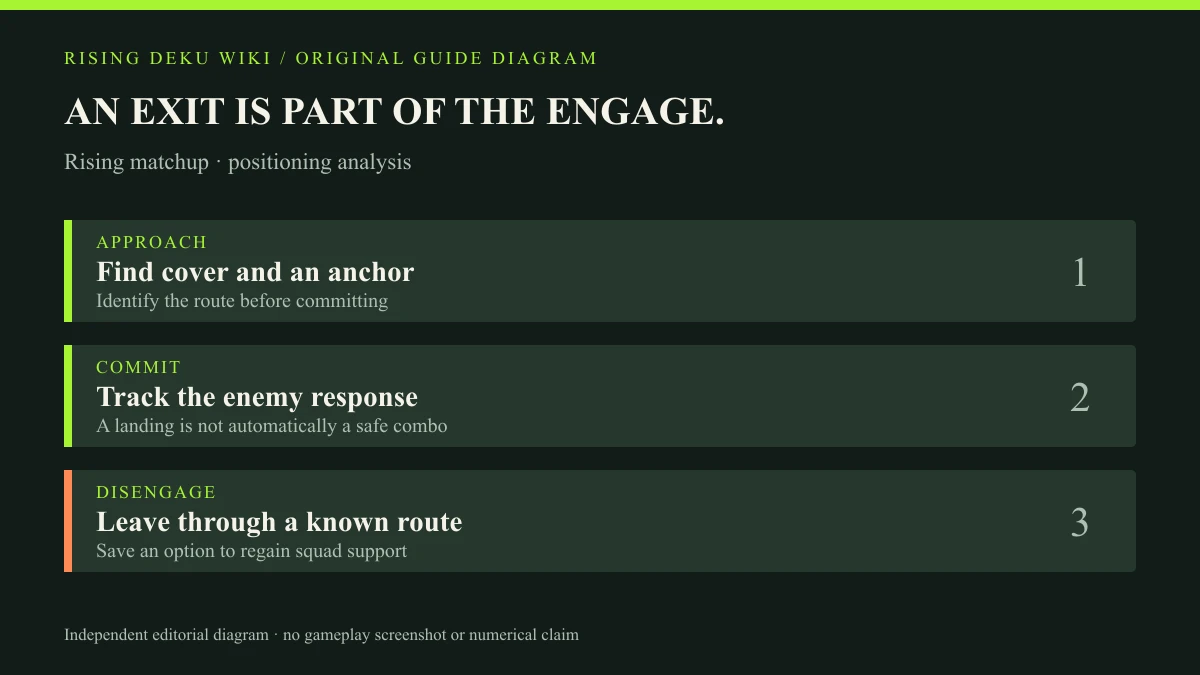
For a new Rising player, a useful first goal is a controlled terrain swing followed by regrouping. Add the charged rush and close-range follow-ups once the movement feels predictable. Judge a first match by whether you stayed with the team and understood your inputs, then build toward more complicated decisions.
Sources and review date
- Bandai Namco game page — 24-player match and three-player team premise.
- Official launch introduction — skill upgrades, civilians and revival resources.
- Official open-beta introduction and gameplay guide — teammate badges, Revival Cards and card types. These explain foundational mechanics; later patch notes take priority for changed rules.
- Official patch notes 1.10.0 — retained skill levels after revival.
- UltraRumble gameplay guide — community detail on card systems.
Reviewed October 14, 2026. Use current in-game instructions for the selected mode and platform’s controls.
Related Articles
guides
Rising Deku Practice Guide: Test Combos, Movement and Builds
Use a repeatable Rising Deku training plan to learn anchor control, test combo escapes and compare skill upgrades without assuming an optimal build.
guides
How to Unlock Rising Deku in MHUR: Rolls and Pool Checks
Check the exact Rising Deku reward, current Roll pool, drop rates and exchange terms before spending tickets in My Hero Ultra Rumble Season 19.
Was this helpful?
Thanks for the feedback!